Monday, December 24, 2012
Neighborly Love
I'm laying in bed listening to the loud purr of Natalie's white diesel truck that she uses to haul produce for her farmer's market job. Natalie lives across the street with her partner, Carl, who is a graphic designer and entrepreneurial whisky salesman.
How do I know these facts? And why I am laying here writing about Natalie's old, decrepit truck? The answer to those questions gets at the heart of this contemplation of "neighborhood."
It wasn't until I moved into my own rented house with friends that knowing my neighbors became important to me. Growing up I never knew or thought to contemplate having a relationship with my neighbors. I was satisfied with my life-family, a dog, school, sports, and friends whose houses I could get driven to, or who could get dropped off at my house. This was my community, and it was all I knew.
College provided its own neighborliness, as I lived in either dorms or co-ops, which were built-in student communities. It makes sense that I never even considered renting an apartment or house during college with friends. I simply could not understand wanting to live elsewhere. Community and relationships were (and still are) the first and foremost thing on my mind. I loved, with a mighty passion, that I lived in a co-op where we shared food, work, and where people hung out in common space with no TV in sight.
Then I left college. I moved into a 5 person house, with friends, onto Shattuck Ave, a busy thoroughfare with a park across the street. I lived there for a year, and occasionally I would have the thought, "Man, I wish I knew the neighbors." Once I gave some of our homegrown collards to the old lady next door, in exchange for using her compost bin for a week. This was about the extent of our house's neighborly affairs.
And then, thank the Lord, we moved just 5 blocks away, onto the quieter 60th street with houses on both sides of the street. All of a sudden we started getting to know our neighbors like a stack of dominoes-one got tipped, and the rest followed.
I believe we owe it mostly to Josh and to two of his many wonderful qualities-his friendliness/willingness to meet and chat with people, and his connections. While working on the front of the house Josh met Natalie, mentioned above. Later it turned out her housemate, Lisa, was a good friend of Josh's dad's girlfriend. Both Lisa and Natalie work for the farmer's market, and they began to drop off huge bags of leftover produce on our front doorstep. Lettuce, carrots, broccoli, beets (so many beets). Josh also knew the landlords of the house two doors down, and so we met them, and invited them over to our housewarming party. I climbed their redwood tree to the top, a 100 foot climb which allowed me to see the Golden Gate Bridge as well as into our backyard.
Our wonderful and friendly neighbors across the street, Chuck and Steve, also know the same landlord that Josh knows, and so we became friendly with them. They invited us over for cocktails one night, and 8 of us twenty-somethings bombarded their home.
The climax of our neighborly love occurred fortuitously on our street, in October. While walking down the street I saw someone who looked familiar. I introduced myself, and found out her name was Trixie, she went to UC Berkeley, and she also lived in the house with the huge redwood tree. We began chatting and, it being the Bay Area and all, we naturally got onto the topic of vegan cheese.
"I couldn't help overhearing. Are you talking about vegan cheese?" said a woman walking by, whose name we found out was Wen, who was with her partner Chris. I said that we were. The conversation then moved onto a topic that had been in my head for a week. Backstory: Lisa, our across the street neighbor, told me about "National Block Party week," a week where various neighborhoods hosted block parties. She told me about the closest one, about a five minute bike ride away.
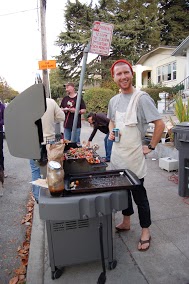
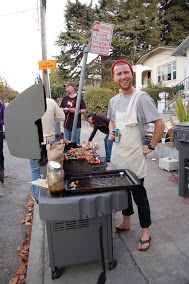
Filled with excitement and curiosity, I pedaled on over to the 62nd and Shattuck Ave. block party. I didn't find it, and I almost gave up, but then I decided to cross the street and try the other side of the block. There I found a sight that still fills my heart with joy. The scene: Cones blocking off both sides of the street, making it pedestrian only. A gigantic BBQ with all kinds of meat cooking. Neighbors had brought all the things neighbors bring to a potluck-potato salad, a giant pasta, cookies, etc.
I didn't know anyone. I began walking around talking to people, asking them about this block party. It turns out this neighborhood hasn't always been like this. About ten years ago, a few neighbors got together to make a "safety watch committee" to address crime on their street. They began hosting meetings, and meeting more of their neighbors, and then they decided to host a yearly block party. I noticed a policeman there, and he told me this street was part of his "beat," and he liked to stop by every year to meet and chat with the neighbors.
Needless to say, I returned home from this block party pumped for this to happen on our own street. But there was the reality of working full-time, not knowing how to do a block party, and prioritizing other things. The block party had hit a road-block. This brings us back to my conversation with Wen, Chris and Trixie.
"Hey, I've been thinking about how cool it would be to have a block party on our street," I told Wen. Her face lit up and she said she had also been thinking about that. I told her about my experience of the 62nd and Shattuck block party. She said she would look into making it happen. I figured nothing would come of it. We parted ways.
Not everyone follows through in life, but Wen does. Two days later she was walking door to door in our neighborhood, getting the required 10 neighbor signatures to hold a block party. She did her research, talked to the city, doled out the 35 bucks necessary to get the permit, and set a date in October for the party.
Three months later our neighbors still talk about how much fun the party was. We grilled meat and veggies, served frittata with eggs from our chickens, and ate really well. We had a sign-up sheet (Wen's idea) to create a 60th street email listserve. I met many of our neighbors, found out some of the history of our street from our older neighbors, and generally glowed inside from the feeling of communing with the people I live closest to in the whole world.
As I sit here I am astounded and blown away by that fact. How can I not know some of the people I live closest to in the whole world?
This question leads me to the foundation of what I write, the questions: What factors create neighborhood community, and what factors make it irrelevant and unnecessary?
I believe so strongly that neighborhood community has always been based on a mutual need for sustenance and connection. "Love thy neighbor," as the Bible tells us, is a beautiful concept on its own, but the real reason to love thy neighbor has always been because we have needed them for something. There are many somethings, but some of these needs include:
-Babysitting
-Borrowing equipment
-Borrowing food
-Having someone to connect with
-Feeling safer in your neighborhood, and knowing people are watching out for you
There are hundreds more needs our neighbors have always fulfilled. But now, in an age of plenty (for some), some of us can meet these needs on our own.
(At this point I must add an important point: I am writing from a white, upper-middle class perspective. Many of the people on my neighborhood are also fairly well-off. It is important that my perspective be known, and that we acknowledge there are many people out there who don't have enough, and whose neighborhood experience and needs will be drastically different from my own.)
If we are out of flour we go to the store to get it. We call and pay for babysitters to watch our kids. We have most of our own equipment, or we buy it if we don't have it. We connect with people differently-often through technology and non face-to-face, like Facebook, email, phone, etc. These are facts of my, and many of your, lives. They are the result of industrializing, having a roof over our heads, having convenience and ease in our lives, and above all, NOT NEEDING EACH OTHER FOR SURVIVAL.
Now, I am not suggesting we somehow give all this up. That's what my 19 year old, idealistic self would have said. I know now that this is the life we have, the one we are living, and that it will gradually change, hopefully in a certain way, but that we have to deal with what is here right now. If we don't "need" our neighbors, then the question is, how do we still connect with them?
I will suggest a few things I have learned, some of which I have already named above:
Be a neighboorhood presence: This could mean walking your dog on the street, playing catch with your kids on the street, mowing your lawn or watering your front plants, sitting on your porch playing banjo, doing a project in your driveway.
Say hello: Always say hello to everyone you see on your street
Have a block party: Already described in detail above
Have a neighborhood email listserve, and have peoples' numbers in your phone.
Create a beautiful, detailed, hand-drawn map of the neighborhood, labeling all the houses, their inhabitants, and relevant contact info. Distribute to all the neighbors. This is something I haven't done, but would really like to
Borrow stuff: Today I borrowed some straw for our animals from Natalie's backyards, and brought her persimmons from our tree. I asked four different neighbors for a packet of yeast and some coconut milk once. We have borrowed construction tools from Bob and Roberta next door.
Give stuff away: I happened to have 12 pounds of cow livers that I no longer wanted in my life, so I emailed the listserve, and one of the neighbors came to get a pound of it. Sadly, I still have 11 pounds left. Besides this, our neighbors have given us apple tarts, banana bread, and too many beets to count.
Invite them to dinner, or even have a game night: Enough said. Sharing food together builds a bond. Laughing and sharing a game is even better.
I am left with some questions: what does this blog I have written bring out for you? What is your experience of neighborhood and community, both as a child and now? What are other ways to connect with our neighbors? How will my needs and desire for neighborhood community shift someday when I have a family?
I would love to hear your thoughts.
With love,
Ryan
I'm laying in bed listening to the loud purr of Natalie's white diesel truck that she uses to haul produce for her farmer's market job. Natalie lives across the street with her partner, Carl, who is a graphic designer and entrepreneurial whisky salesman.
How do I know these facts? And why I am laying here writing about Natalie's old, decrepit truck? The answer to those questions gets at the heart of this contemplation of "neighborhood."
It wasn't until I moved into my own rented house with friends that knowing my neighbors became important to me. Growing up I never knew or thought to contemplate having a relationship with my neighbors. I was satisfied with my life-family, a dog, school, sports, and friends whose houses I could get driven to, or who could get dropped off at my house. This was my community, and it was all I knew.
College provided its own neighborliness, as I lived in either dorms or co-ops, which were built-in student communities. It makes sense that I never even considered renting an apartment or house during college with friends. I simply could not understand wanting to live elsewhere. Community and relationships were (and still are) the first and foremost thing on my mind. I loved, with a mighty passion, that I lived in a co-op where we shared food, work, and where people hung out in common space with no TV in sight.
Then I left college. I moved into a 5 person house, with friends, onto Shattuck Ave, a busy thoroughfare with a park across the street. I lived there for a year, and occasionally I would have the thought, "Man, I wish I knew the neighbors." Once I gave some of our homegrown collards to the old lady next door, in exchange for using her compost bin for a week. This was about the extent of our house's neighborly affairs.
And then, thank the Lord, we moved just 5 blocks away, onto the quieter 60th street with houses on both sides of the street. All of a sudden we started getting to know our neighbors like a stack of dominoes-one got tipped, and the rest followed.
I believe we owe it mostly to Josh and to two of his many wonderful qualities-his friendliness/willingness to meet and chat with people, and his connections. While working on the front of the house Josh met Natalie, mentioned above. Later it turned out her housemate, Lisa, was a good friend of Josh's dad's girlfriend. Both Lisa and Natalie work for the farmer's market, and they began to drop off huge bags of leftover produce on our front doorstep. Lettuce, carrots, broccoli, beets (so many beets). Josh also knew the landlords of the house two doors down, and so we met them, and invited them over to our housewarming party. I climbed their redwood tree to the top, a 100 foot climb which allowed me to see the Golden Gate Bridge as well as into our backyard.
Our wonderful and friendly neighbors across the street, Chuck and Steve, also know the same landlord that Josh knows, and so we became friendly with them. They invited us over for cocktails one night, and 8 of us twenty-somethings bombarded their home.
The climax of our neighborly love occurred fortuitously on our street, in October. While walking down the street I saw someone who looked familiar. I introduced myself, and found out her name was Trixie, she went to UC Berkeley, and she also lived in the house with the huge redwood tree. We began chatting and, it being the Bay Area and all, we naturally got onto the topic of vegan cheese.
"I couldn't help overhearing. Are you talking about vegan cheese?" said a woman walking by, whose name we found out was Wen, who was with her partner Chris. I said that we were. The conversation then moved onto a topic that had been in my head for a week. Backstory: Lisa, our across the street neighbor, told me about "National Block Party week," a week where various neighborhoods hosted block parties. She told me about the closest one, about a five minute bike ride away.
Filled with excitement and curiosity, I pedaled on over to the 62nd and Shattuck Ave. block party. I didn't find it, and I almost gave up, but then I decided to cross the street and try the other side of the block. There I found a sight that still fills my heart with joy. The scene: Cones blocking off both sides of the street, making it pedestrian only. A gigantic BBQ with all kinds of meat cooking. Neighbors had brought all the things neighbors bring to a potluck-potato salad, a giant pasta, cookies, etc.
I didn't know anyone. I began walking around talking to people, asking them about this block party. It turns out this neighborhood hasn't always been like this. About ten years ago, a few neighbors got together to make a "safety watch committee" to address crime on their street. They began hosting meetings, and meeting more of their neighbors, and then they decided to host a yearly block party. I noticed a policeman there, and he told me this street was part of his "beat," and he liked to stop by every year to meet and chat with the neighbors.
Needless to say, I returned home from this block party pumped for this to happen on our own street. But there was the reality of working full-time, not knowing how to do a block party, and prioritizing other things. The block party had hit a road-block. This brings us back to my conversation with Wen, Chris and Trixie.
"Hey, I've been thinking about how cool it would be to have a block party on our street," I told Wen. Her face lit up and she said she had also been thinking about that. I told her about my experience of the 62nd and Shattuck block party. She said she would look into making it happen. I figured nothing would come of it. We parted ways.
Not everyone follows through in life, but Wen does. Two days later she was walking door to door in our neighborhood, getting the required 10 neighbor signatures to hold a block party. She did her research, talked to the city, doled out the 35 bucks necessary to get the permit, and set a date in October for the party.
Three months later our neighbors still talk about how much fun the party was. We grilled meat and veggies, served frittata with eggs from our chickens, and ate really well. We had a sign-up sheet (Wen's idea) to create a 60th street email listserve. I met many of our neighbors, found out some of the history of our street from our older neighbors, and generally glowed inside from the feeling of communing with the people I live closest to in the whole world.
As I sit here I am astounded and blown away by that fact. How can I not know some of the people I live closest to in the whole world?
This question leads me to the foundation of what I write, the questions: What factors create neighborhood community, and what factors make it irrelevant and unnecessary?
I believe so strongly that neighborhood community has always been based on a mutual need for sustenance and connection. "Love thy neighbor," as the Bible tells us, is a beautiful concept on its own, but the real reason to love thy neighbor has always been because we have needed them for something. There are many somethings, but some of these needs include:
-Babysitting
-Borrowing equipment
-Borrowing food
-Having someone to connect with
-Feeling safer in your neighborhood, and knowing people are watching out for you
There are hundreds more needs our neighbors have always fulfilled. But now, in an age of plenty (for some), some of us can meet these needs on our own.
(At this point I must add an important point: I am writing from a white, upper-middle class perspective. Many of the people on my neighborhood are also fairly well-off. It is important that my perspective be known, and that we acknowledge there are many people out there who don't have enough, and whose neighborhood experience and needs will be drastically different from my own.)
If we are out of flour we go to the store to get it. We call and pay for babysitters to watch our kids. We have most of our own equipment, or we buy it if we don't have it. We connect with people differently-often through technology and non face-to-face, like Facebook, email, phone, etc. These are facts of my, and many of your, lives. They are the result of industrializing, having a roof over our heads, having convenience and ease in our lives, and above all, NOT NEEDING EACH OTHER FOR SURVIVAL.
Now, I am not suggesting we somehow give all this up. That's what my 19 year old, idealistic self would have said. I know now that this is the life we have, the one we are living, and that it will gradually change, hopefully in a certain way, but that we have to deal with what is here right now. If we don't "need" our neighbors, then the question is, how do we still connect with them?
I will suggest a few things I have learned, some of which I have already named above:
Be a neighboorhood presence: This could mean walking your dog on the street, playing catch with your kids on the street, mowing your lawn or watering your front plants, sitting on your porch playing banjo, doing a project in your driveway.
Say hello: Always say hello to everyone you see on your street
Have a block party: Already described in detail above
Have a neighborhood email listserve, and have peoples' numbers in your phone.
Create a beautiful, detailed, hand-drawn map of the neighborhood, labeling all the houses, their inhabitants, and relevant contact info. Distribute to all the neighbors. This is something I haven't done, but would really like to
Borrow stuff: Today I borrowed some straw for our animals from Natalie's backyards, and brought her persimmons from our tree. I asked four different neighbors for a packet of yeast and some coconut milk once. We have borrowed construction tools from Bob and Roberta next door.
Give stuff away: I happened to have 12 pounds of cow livers that I no longer wanted in my life, so I emailed the listserve, and one of the neighbors came to get a pound of it. Sadly, I still have 11 pounds left. Besides this, our neighbors have given us apple tarts, banana bread, and too many beets to count.
Invite them to dinner, or even have a game night: Enough said. Sharing food together builds a bond. Laughing and sharing a game is even better.
I am left with some questions: what does this blog I have written bring out for you? What is your experience of neighborhood and community, both as a child and now? What are other ways to connect with our neighbors? How will my needs and desire for neighborhood community shift someday when I have a family?
I would love to hear your thoughts.
With love,
Ryan
Saturday, March 3, 2012
Wednesday, July 21, 2010
Be A Channel, Not A Dam
Picture of Hamsa
We have a saying at the camp I work at. It is one of my most favorite sayings and concepts in the whole world. It goes: Be a Channel, Not a Dam. It means this: instead of projecting onto kids what you think they should do or be, start where they are at. If a kid is feeling energetic and you had in mind a quiet activity, meet them where they are at and make it more active. It allows kids to be who they are and to channel their wonderful emotions and energy into something positive. Instead of a dam, which becomes blocked up and eventually, if not let out, will explode.
There is an ancient, beautiful symbol called a Hamsa. It originated in Northern Africa before the advent of modern religions like Judaism, Christianity, and Islam. Throughout the years, it has gradually become an important and popular symbol of protection and good luck for the Jewish people. In many homes in Israel, it's very common to see a whole collection of these Hamsas.
Part of my job at camp is to teach at least one Jewish activity per session with the campers, and the Hamsa was a symbol I decided to use for an activity with my bunk of 7 campers. They are 10 years old, and incredibly silly and rambunctious. They had been having a lot of fun at camp, and I wanted to also make sure they could have a more serious, meaningful experience where they could share personal feelings and get to know deeper sides of each other.
So with some help from some creative people, I designed an activity. This was the plan: Go to Arts and Crafts. Collect about 20 sticks each. On a huge piece of butcher paper, we were going to draw an outline of a body. They were all going to write some of their own perceived strengths and weaknesses on the body. After that, we would go around and share what we wrote. After each strength or weakness, people would throw a stick into the center to show that they also felt they had this strength and weakness. The whole point of the activity was to highlight all of our various unique strengths and also show that we are not alone in our "weaknesses." It's a pretty cool activity, with the potential to remind kids of their strengths and also show them their weaknesses can really be strengths.
After that, we would all decorate our own symbolic protective hamsas on a piece of plastic called a "Shrinky-Dink," which you then put into the oven so that the design remains but the paper shrinks to about a quarter of the size. Then we would make necklaces of them and wear them around camp, to remind us of our strengths and also to help us feel safe and protected.
I huddled them up before hand and talked to them about the more serious, meaningful tone we were trying to set. I wanted this for them. I wanted them to get to have a meaningful experience.
But life rarely goes as planned.
As the activity began, they started going crazy as only 10 year olds can. They collected 5 foot sticks instead of twigs like I asked them, they started trying to hit each other with the sticks. They wrote weaknesses like "I have flat feet" and strengths like "I can see with my eyes" when I had imagined they would go deeper and talk about sensitivity, or being too judgmental. When we tried to share, no one was listening, kids would get up and run around and I'd have to drag them back to the table. They fought each other for the sticks.
Boy was this frustrating. This was for them, right? I started feeling angry, telling them they weren't being respectful, that I expected more from them, that I had designed this activity especially for them. I even threatened them with not doing the shrinky dinks if they kept going. It got so bad that I reached this boiling point where I was almost about to say, "That's it. We're done. We're not going to finish the activity."
And then, and then, something magical happened. I actually got out of my head and my own ideas of how things should be and I LOOKED AROUND. What I saw was a beautiful sight. They were all laughing with each other, having fun. Some were rolling on the floor, they were laughing so hard. They were cracking jokes and sharing their humor with each other. And you know what I did? I started laughing too. Because, I realized, it didn't matter what me Ryan Cole wanted for these kids. It was about who they were and what they needed. And they weren't 22 yet, and they weren't needing to go so deep, at least in this moment, and share their most profound and intimate feelings. No, they were 10, and they were needing to be silly 10 year olds and experience the joy of the world through laughter and stick fighting and all the wonders of being just 10.
I had cast my own, unfair expectations on them. The activity was truly about them being themselves and seeing that was not just okay, but beautiful. Who was I to try to change them in this moment? Who was I to have this idea of who and how they should be? To fit them into a box that cramped their style. To mold them into what, for some reason, our society has told us a child can or cannot be? So I let go, and 10 year olds got to be themselves in a world that doesn't often allow it, and their laughter rang into the night. I handed them the shrinky dink paper and they made the designs how they wanted to, and when the night ended, we all had shrinky dink Hamsa necklaces, and they all felt a little closer because they got to be themselves in front of each other.
I go in the Tuolome River every day here. I watch and learn from it. When the river comes to an obstacle, like a rock, it doesn't get stuck, or try to burst through it. It just splits itself and goes around, and rejoins on the other side. I want to be like the river. I want to be a channel, not a dam. Life has a flow, and listening to it, and being a leaf in that river, is a very beautiful thing, I am learning.
Love,
Ryan
We have a saying at the camp I work at. It is one of my most favorite sayings and concepts in the whole world. It goes: Be a Channel, Not a Dam. It means this: instead of projecting onto kids what you think they should do or be, start where they are at. If a kid is feeling energetic and you had in mind a quiet activity, meet them where they are at and make it more active. It allows kids to be who they are and to channel their wonderful emotions and energy into something positive. Instead of a dam, which becomes blocked up and eventually, if not let out, will explode.
There is an ancient, beautiful symbol called a Hamsa. It originated in Northern Africa before the advent of modern religions like Judaism, Christianity, and Islam. Throughout the years, it has gradually become an important and popular symbol of protection and good luck for the Jewish people. In many homes in Israel, it's very common to see a whole collection of these Hamsas.
Part of my job at camp is to teach at least one Jewish activity per session with the campers, and the Hamsa was a symbol I decided to use for an activity with my bunk of 7 campers. They are 10 years old, and incredibly silly and rambunctious. They had been having a lot of fun at camp, and I wanted to also make sure they could have a more serious, meaningful experience where they could share personal feelings and get to know deeper sides of each other.
So with some help from some creative people, I designed an activity. This was the plan: Go to Arts and Crafts. Collect about 20 sticks each. On a huge piece of butcher paper, we were going to draw an outline of a body. They were all going to write some of their own perceived strengths and weaknesses on the body. After that, we would go around and share what we wrote. After each strength or weakness, people would throw a stick into the center to show that they also felt they had this strength and weakness. The whole point of the activity was to highlight all of our various unique strengths and also show that we are not alone in our "weaknesses." It's a pretty cool activity, with the potential to remind kids of their strengths and also show them their weaknesses can really be strengths.
After that, we would all decorate our own symbolic protective hamsas on a piece of plastic called a "Shrinky-Dink," which you then put into the oven so that the design remains but the paper shrinks to about a quarter of the size. Then we would make necklaces of them and wear them around camp, to remind us of our strengths and also to help us feel safe and protected.
I huddled them up before hand and talked to them about the more serious, meaningful tone we were trying to set. I wanted this for them. I wanted them to get to have a meaningful experience.
But life rarely goes as planned.
As the activity began, they started going crazy as only 10 year olds can. They collected 5 foot sticks instead of twigs like I asked them, they started trying to hit each other with the sticks. They wrote weaknesses like "I have flat feet" and strengths like "I can see with my eyes" when I had imagined they would go deeper and talk about sensitivity, or being too judgmental. When we tried to share, no one was listening, kids would get up and run around and I'd have to drag them back to the table. They fought each other for the sticks.
Boy was this frustrating. This was for them, right? I started feeling angry, telling them they weren't being respectful, that I expected more from them, that I had designed this activity especially for them. I even threatened them with not doing the shrinky dinks if they kept going. It got so bad that I reached this boiling point where I was almost about to say, "That's it. We're done. We're not going to finish the activity."
And then, and then, something magical happened. I actually got out of my head and my own ideas of how things should be and I LOOKED AROUND. What I saw was a beautiful sight. They were all laughing with each other, having fun. Some were rolling on the floor, they were laughing so hard. They were cracking jokes and sharing their humor with each other. And you know what I did? I started laughing too. Because, I realized, it didn't matter what me Ryan Cole wanted for these kids. It was about who they were and what they needed. And they weren't 22 yet, and they weren't needing to go so deep, at least in this moment, and share their most profound and intimate feelings. No, they were 10, and they were needing to be silly 10 year olds and experience the joy of the world through laughter and stick fighting and all the wonders of being just 10.
I had cast my own, unfair expectations on them. The activity was truly about them being themselves and seeing that was not just okay, but beautiful. Who was I to try to change them in this moment? Who was I to have this idea of who and how they should be? To fit them into a box that cramped their style. To mold them into what, for some reason, our society has told us a child can or cannot be? So I let go, and 10 year olds got to be themselves in a world that doesn't often allow it, and their laughter rang into the night. I handed them the shrinky dink paper and they made the designs how they wanted to, and when the night ended, we all had shrinky dink Hamsa necklaces, and they all felt a little closer because they got to be themselves in front of each other.
I go in the Tuolome River every day here. I watch and learn from it. When the river comes to an obstacle, like a rock, it doesn't get stuck, or try to burst through it. It just splits itself and goes around, and rejoins on the other side. I want to be like the river. I want to be a channel, not a dam. Life has a flow, and listening to it, and being a leaf in that river, is a very beautiful thing, I am learning.
Love,
Ryan
Monday, April 26, 2010
John
This story is too heartwarming not to relate...
Today, I was at People's Park in Berkeley for the park's 41st anniversary. I was tabling for the Berkeley Free Clinic, where I volunteer as a peer counselor, so we had all kinds of characters approach our table. One was a 45 year old guy named John, and he graced us with his incredible story. Here it is.
In his younger days, John was a firefighter. Back then, they relied more on person to person communication out in the field, rather than by radio. As they were fighting a fire, John was approaching the edge of a cliff. The person who was supposed to be looking out did not communicate that the cliff was near, and so John fell over the cliff, plunging 90 feet through a thicket of trees, finally landing on some boulders. He instantly shattered both of his knee caps, and according to him, "I broke 99 percent of the bones in my body."
After recovering, John became homeless. He got into meth, both dealing and using. He said his cycle was to sell meth until he could buy enough meth to go up into the Berkeley hills, where he would spend several months consistently high. When the drugs were used up, he would return to deal more, until he could go back to the hills.
One time, after finishing a 60 day stint on meth in the hills, something changed for John. The moment his foot hit the sidewalk on his return, his mind snapped, and he realized he needed to stop what he was doing and sober up. He gave away his remaining drugs, telling everyone he knew, "Never ask me for this ever again." He sobered up on his own, and also got a couple of his friends to sober up. They moved into Section 1A housing (free government housing).
"John," I asked. "So many people in your situation don't make it. Why are you different? Why did you make it?" He pointed to his right, where his 13 year old daughter stood. "Everything was for her," he said. "Without her, I wouldn't have cared about myself enough to change."
This is the first of three points he and I were able to identify in what is responsible for someone making it (or not making it) out of a tough situation. Here are the three:
1. Having a higher purpose, something outside of yourself. For some people recovering, that purpose becomes a higher power, like God. But it can just as well be someone else in your life, or an ideal you believe in. Perhaps because when you're in addiction you're so mired in your own problems, you need to believe in something outside of yourself to escape it.
2. Community Support. John had people around him (like his daughter) who believed in him, who supported him, who kept him honest. He admitted, he could not have maintained his soberness alone. He needed people. We need people.
3. The will and desire John wanted it so bad, wanted so badly to get his daughter back, that it fueled him whenever he was feeling weak. He discovered that indomitable human spirit that exists in all of us. When he tapped into that, already having a higher purpose and community support, he could make it.
John said he sobered up in 2007, and that today, April 2010, was his first day back in the park since then. He now raises his 13 year old daughter and helps people who are addicted get off their addictions by getting them in programs. The man has a certain vibe, an aura around him. It is one you can only have when you have been to hell and back, when you have seen the darkest night imaginable, the darkest depth of the human spirit, and returned to the light. To go away and come back, to struggle and persevere, to lose everything and regain it, seems like one of the most incredible blessings we could receive.
I forgot to mention, due to his 90 foot plunge off the cliff, John is in constant pain. He's got a pretty sunny disposition, too. How does he do it?
I look at John and I think that he's special, but I think we all have that within us. Maybe we don't see it until we encounter something dark and despairing, but it's there, as sure as your beating heart. When we tap into the best part of ourselves, we can always do it.
Here's to you, John, for the joy you bring to the world.
With love,
Ryan
Today, I was at People's Park in Berkeley for the park's 41st anniversary. I was tabling for the Berkeley Free Clinic, where I volunteer as a peer counselor, so we had all kinds of characters approach our table. One was a 45 year old guy named John, and he graced us with his incredible story. Here it is.
In his younger days, John was a firefighter. Back then, they relied more on person to person communication out in the field, rather than by radio. As they were fighting a fire, John was approaching the edge of a cliff. The person who was supposed to be looking out did not communicate that the cliff was near, and so John fell over the cliff, plunging 90 feet through a thicket of trees, finally landing on some boulders. He instantly shattered both of his knee caps, and according to him, "I broke 99 percent of the bones in my body."
After recovering, John became homeless. He got into meth, both dealing and using. He said his cycle was to sell meth until he could buy enough meth to go up into the Berkeley hills, where he would spend several months consistently high. When the drugs were used up, he would return to deal more, until he could go back to the hills.
One time, after finishing a 60 day stint on meth in the hills, something changed for John. The moment his foot hit the sidewalk on his return, his mind snapped, and he realized he needed to stop what he was doing and sober up. He gave away his remaining drugs, telling everyone he knew, "Never ask me for this ever again." He sobered up on his own, and also got a couple of his friends to sober up. They moved into Section 1A housing (free government housing).
"John," I asked. "So many people in your situation don't make it. Why are you different? Why did you make it?" He pointed to his right, where his 13 year old daughter stood. "Everything was for her," he said. "Without her, I wouldn't have cared about myself enough to change."
This is the first of three points he and I were able to identify in what is responsible for someone making it (or not making it) out of a tough situation. Here are the three:
1. Having a higher purpose, something outside of yourself. For some people recovering, that purpose becomes a higher power, like God. But it can just as well be someone else in your life, or an ideal you believe in. Perhaps because when you're in addiction you're so mired in your own problems, you need to believe in something outside of yourself to escape it.
2. Community Support. John had people around him (like his daughter) who believed in him, who supported him, who kept him honest. He admitted, he could not have maintained his soberness alone. He needed people. We need people.
3. The will and desire John wanted it so bad, wanted so badly to get his daughter back, that it fueled him whenever he was feeling weak. He discovered that indomitable human spirit that exists in all of us. When he tapped into that, already having a higher purpose and community support, he could make it.
John said he sobered up in 2007, and that today, April 2010, was his first day back in the park since then. He now raises his 13 year old daughter and helps people who are addicted get off their addictions by getting them in programs. The man has a certain vibe, an aura around him. It is one you can only have when you have been to hell and back, when you have seen the darkest night imaginable, the darkest depth of the human spirit, and returned to the light. To go away and come back, to struggle and persevere, to lose everything and regain it, seems like one of the most incredible blessings we could receive.
I forgot to mention, due to his 90 foot plunge off the cliff, John is in constant pain. He's got a pretty sunny disposition, too. How does he do it?
I look at John and I think that he's special, but I think we all have that within us. Maybe we don't see it until we encounter something dark and despairing, but it's there, as sure as your beating heart. When we tap into the best part of ourselves, we can always do it.
Here's to you, John, for the joy you bring to the world.
With love,
Ryan
Wednesday, April 21, 2010
Hold Your Breath--I'm Eating Vegan! (Gasp)
I just deleted the blog post I had been writing for the last hour. Bam. Wiped the slate clean. I rarely do this, but as I was writing it became apparent to me I was lost in my own discussion. And it's because I have so much to say! So I'm going to break it down much more simple, and leave the facts and arguments for a later time.
I am eating vegan!
To clarify, especially for my Uncle Ron, who took me to a vegan restaurant in Berkeley and asked me what a "vegan" (he pronounced it "vagan") is, here goes: to eat vegan is to eat no animal or animal by products, including: beef, chicken, fish, turkey, eggs, dairy, gelatin.
Why in God's good name would I undertake such a crazzzzy undertaking, you ask?
Well, it turns out that for my current beliefs-about the environment, animal treatment, farmworker's rights, industrialization, small business being shut down--eating anything but vegan simply doesn't match up. What I'm saying is, at least for right now, I can't feel good about making food choices besides vegan.
I would like to say at this moment that I am purposely NOT writing to judge, persuade, or convince anyone. I am writing about myself, my thoughts, and my own experience. I think people can do whatever the heck they want. I would hope for them they have the privilege of feeling good about what they do, and I think you can have this eating any kind of diet you want. But for me, at this tender time in my life, I simply cannot eat non-vegan and feel good about it.
My reasons, which are numerous, are so scattered and new and all over the place that I'm not even going to try to go into all of them, or even most of them. I need time for them to settle, so I can talk about it in a clearer, perhaps even more objective way.
For now, I'll try to simplify it. Girl gives talk at my co-op. About factory farming. She brings vegan ice cream and homemade cookies, which incentivize me to attend. She gives 45 minute presentation about factory farming and veganism. I am so taken aback that I (and seven other people in my house) decide to eat vegan for one week. We call it the "vegan challenge." (To clarify, I am simply eating vegan now, with no one week limit to it.)
What, you may ask, would ever convince me to give up the Fish and California Burrito at Sarita's? I'm just going to offer one reason for now, and it is the first one that hit me.
Here is ever reliable Wikipedia's definition of "factory farming": "Factory farming is the practice of raising livestock in confinement at high stocking density, where a farm operates as a factory." Basically, a factory farm is one where, generally, animals are crammed into a space that is too small for them, given a modified diet, and subjected to external forces like 24 hour bright lighting to encourage maximum production.
What picture do you see on the package when you're at the grocery store and you're buying bacon, or eggs, or whatever we buy? I often see an idyllic farm with a small red barn, hay, horses, a happy farmer on a tractor. Apparently, I learned, it is simply not the case. A staggering fact: 99% of our animal and animal byproducts in the country are produced at Factory Farms. When I heard that, I was like, "Dayammmmm."
What's wrong with factory farms? Many things, but for now, I will offer the treatment of animals. I recognize that doesn't resonate with everyone, and so I think it is important to elucidate all the different arguments against factory farming. But i want to focus on what initially struck me.
Baby chicks. Baby chicks in a factory farm are typically given the space of an 8x11 piece of paper. They are crammed sometimes 30,000 chicks to a relatively small space. That sounds rough, but this is the part I can't stop thinking about: it is common practice to CUT OFF baby chick's beaks (often without anaesthetic). Why would anyone cut off a baby chick's beak? Well, because of the conditions of the factory farm (lack of space, 24 hour bright lighting to stimulate growth and production, etc.--baby chicks would literally peck each other to death if they had their beaks.
In different settings, be it out in the wild or even in a regular farm (the kind that was the majority until about the 1960's), chickens use their beaks to establish a pecking order, ensuring stability. But in a factory farm, a chicken's beak must be cut off.
Before we get to posing all-or-nothing hypotheticals (well, would you rather us have enough food to eat, or keep your chick's beak on), let's stop. Let's think about our values, what we truly hold dear to our hearts. And then let us, for a moment, consider what it means for us, as a society, to engage in a practice in which we cut off chicken's beaks. A chicken's beak is the first thing that sees this beautiful world. It helps it break out of its shell and breathe our air. And then it uses its beak to feed, as well as to defend itself. It is comparable to our human mouth.
I'm sorry, but I wouldn't want to be part of a society like that.
Well, what about cage free or free-range chickens? I thought the same until I heard this presentation. It turns out cage free or free-range means almost nothing. You could cram 30,000 chickens into a small barn with 8x11 piece of paper space per chicken, and if you have a 3x3 foot area outside, then your chicken is "free-range." But not even free to roam that 3x3 foot area, since the door to it is rarely open and there's not room to move anyways. As the author of a book I'm reading said, "I could keep my chickens under my sink and call them free-range."
And 99% of our chicken meat and eggs are produced this way.
Here is where I run into my dilemma. As I said earlier, I'm really not writing this to try to persuade you, to make you feel bad, to even do anything. I wanted to share my experience and what moved me. And I fear my rhetoric is already moralistic, judgmental. I fear that as soon as I write this I am labeled "a vegan" and cast into a category. Well, all I can do I suppose is state my intention to avoid that.
No, what I want is to continue engaging people in dialog (notice, not "debate") about the food we eat. I want to know, in as caring and non-judgmental a way as possible, why are you choosing to eat that?
Is it because it tastes good to you?
Is it health, because you believe meat and dairy and eggs is the best and perhaps only source of reliable protein?
Is it economics, that you can only afford a certain type and quality of meat and dairy and eggs?
Is it lack of awareness and knowledge of what food you are eating?
Is it apathy, that you just don't care?
Is it that you don't have the time to find out?
These to me all are valid reasons. You can have whatever reason you want, and I just want to engage with it, know about it. I want to know where people are coming from. Say I did become so passionate about eating vegan that I wanted to convince people to change their eating habits-what good would it do for me to condescend and belittle people for their food choices? We judge each other all the time. I think we need to listen to each other. In an honest and caring way.
Where do I go from here? Oh lordy, I have so much to say. I might just keep writing blogs about this. I could write about all the facts related to factory farming I'm finding out (some from a movie called Food Inc. that I highly recommend!). I could write about my experience of eating vegan, from a health/food perspective as well as a social perspective. I could write about my conversations with people. Really, there's a lot to say.
But this is a start. This is my proclamation to the world, at this moment in time, that I'm eating vegan. And I would like to talk about it. I would like us all to talk with one another. Because when we do that from a place of care, compassion, and genuine, non-judgmental curiosity, we learn from each other, and good things happen. Maybe that's the most important thing I've learned at college, and I sure as heck did not learn that in the classroom.
With love,
Ryan
*A woman named Carolyn just emailed me with a link to her blog, which has 100 useful links for people interested in vegetarian/vegan diets. Here's the link: http://surgicaltechnicianschools.org/?page_id=131
I am eating vegan!
To clarify, especially for my Uncle Ron, who took me to a vegan restaurant in Berkeley and asked me what a "vegan" (he pronounced it "vagan") is, here goes: to eat vegan is to eat no animal or animal by products, including: beef, chicken, fish, turkey, eggs, dairy, gelatin.
Why in God's good name would I undertake such a crazzzzy undertaking, you ask?
Well, it turns out that for my current beliefs-about the environment, animal treatment, farmworker's rights, industrialization, small business being shut down--eating anything but vegan simply doesn't match up. What I'm saying is, at least for right now, I can't feel good about making food choices besides vegan.
I would like to say at this moment that I am purposely NOT writing to judge, persuade, or convince anyone. I am writing about myself, my thoughts, and my own experience. I think people can do whatever the heck they want. I would hope for them they have the privilege of feeling good about what they do, and I think you can have this eating any kind of diet you want. But for me, at this tender time in my life, I simply cannot eat non-vegan and feel good about it.
My reasons, which are numerous, are so scattered and new and all over the place that I'm not even going to try to go into all of them, or even most of them. I need time for them to settle, so I can talk about it in a clearer, perhaps even more objective way.
For now, I'll try to simplify it. Girl gives talk at my co-op. About factory farming. She brings vegan ice cream and homemade cookies, which incentivize me to attend. She gives 45 minute presentation about factory farming and veganism. I am so taken aback that I (and seven other people in my house) decide to eat vegan for one week. We call it the "vegan challenge." (To clarify, I am simply eating vegan now, with no one week limit to it.)
What, you may ask, would ever convince me to give up the Fish and California Burrito at Sarita's? I'm just going to offer one reason for now, and it is the first one that hit me.
Here is ever reliable Wikipedia's definition of "factory farming": "Factory farming is the practice of raising livestock in confinement at high stocking density, where a farm operates as a factory." Basically, a factory farm is one where, generally, animals are crammed into a space that is too small for them, given a modified diet, and subjected to external forces like 24 hour bright lighting to encourage maximum production.
What picture do you see on the package when you're at the grocery store and you're buying bacon, or eggs, or whatever we buy? I often see an idyllic farm with a small red barn, hay, horses, a happy farmer on a tractor. Apparently, I learned, it is simply not the case. A staggering fact: 99% of our animal and animal byproducts in the country are produced at Factory Farms. When I heard that, I was like, "Dayammmmm."
What's wrong with factory farms? Many things, but for now, I will offer the treatment of animals. I recognize that doesn't resonate with everyone, and so I think it is important to elucidate all the different arguments against factory farming. But i want to focus on what initially struck me.
Baby chicks. Baby chicks in a factory farm are typically given the space of an 8x11 piece of paper. They are crammed sometimes 30,000 chicks to a relatively small space. That sounds rough, but this is the part I can't stop thinking about: it is common practice to CUT OFF baby chick's beaks (often without anaesthetic). Why would anyone cut off a baby chick's beak? Well, because of the conditions of the factory farm (lack of space, 24 hour bright lighting to stimulate growth and production, etc.--baby chicks would literally peck each other to death if they had their beaks.
In different settings, be it out in the wild or even in a regular farm (the kind that was the majority until about the 1960's), chickens use their beaks to establish a pecking order, ensuring stability. But in a factory farm, a chicken's beak must be cut off.
Before we get to posing all-or-nothing hypotheticals (well, would you rather us have enough food to eat, or keep your chick's beak on), let's stop. Let's think about our values, what we truly hold dear to our hearts. And then let us, for a moment, consider what it means for us, as a society, to engage in a practice in which we cut off chicken's beaks. A chicken's beak is the first thing that sees this beautiful world. It helps it break out of its shell and breathe our air. And then it uses its beak to feed, as well as to defend itself. It is comparable to our human mouth.
I'm sorry, but I wouldn't want to be part of a society like that.
Well, what about cage free or free-range chickens? I thought the same until I heard this presentation. It turns out cage free or free-range means almost nothing. You could cram 30,000 chickens into a small barn with 8x11 piece of paper space per chicken, and if you have a 3x3 foot area outside, then your chicken is "free-range." But not even free to roam that 3x3 foot area, since the door to it is rarely open and there's not room to move anyways. As the author of a book I'm reading said, "I could keep my chickens under my sink and call them free-range."
And 99% of our chicken meat and eggs are produced this way.
Here is where I run into my dilemma. As I said earlier, I'm really not writing this to try to persuade you, to make you feel bad, to even do anything. I wanted to share my experience and what moved me. And I fear my rhetoric is already moralistic, judgmental. I fear that as soon as I write this I am labeled "a vegan" and cast into a category. Well, all I can do I suppose is state my intention to avoid that.
No, what I want is to continue engaging people in dialog (notice, not "debate") about the food we eat. I want to know, in as caring and non-judgmental a way as possible, why are you choosing to eat that?
Is it because it tastes good to you?
Is it health, because you believe meat and dairy and eggs is the best and perhaps only source of reliable protein?
Is it economics, that you can only afford a certain type and quality of meat and dairy and eggs?
Is it lack of awareness and knowledge of what food you are eating?
Is it apathy, that you just don't care?
Is it that you don't have the time to find out?
These to me all are valid reasons. You can have whatever reason you want, and I just want to engage with it, know about it. I want to know where people are coming from. Say I did become so passionate about eating vegan that I wanted to convince people to change their eating habits-what good would it do for me to condescend and belittle people for their food choices? We judge each other all the time. I think we need to listen to each other. In an honest and caring way.
Where do I go from here? Oh lordy, I have so much to say. I might just keep writing blogs about this. I could write about all the facts related to factory farming I'm finding out (some from a movie called Food Inc. that I highly recommend!). I could write about my experience of eating vegan, from a health/food perspective as well as a social perspective. I could write about my conversations with people. Really, there's a lot to say.
But this is a start. This is my proclamation to the world, at this moment in time, that I'm eating vegan. And I would like to talk about it. I would like us all to talk with one another. Because when we do that from a place of care, compassion, and genuine, non-judgmental curiosity, we learn from each other, and good things happen. Maybe that's the most important thing I've learned at college, and I sure as heck did not learn that in the classroom.
With love,
Ryan
*A woman named Carolyn just emailed me with a link to her blog, which has 100 useful links for people interested in vegetarian/vegan diets. Here's the link: http://surgicaltechnicianschools.org/?page_id=131
Wednesday, March 31, 2010
Outside a Video Store in Berkeley, CA
It wasn't until an hour had passed and I was getting up to return to my house that he told me his name was Kenneth.
Kenneth Winters. A pretty normal sounding name, I'd say. Who do you picture when you hear that name? I picture someone aristocratic, perhaps with a stiff, starched collar and dress shirt.
That's not who Kenneth Winters is, though. Kenneth is a man I met today outside of the video store. Earlier today I read this article from a daily, positive news email service called The Daily Good (http://www.dailygood.org/) It was an inspiring article about Jaime Escalante, a Bolivian-born teacher at a low-income mostly minority school in East L.A. Escalante helped high school kids--who no one thought could do a whole lot--to pass the AP Calculus test at an astonishing success rate. Anyway, the article mentioned there was a movie made in 1988 called Stand and Deliver about Escalante's story (http://www.dailygood.org/view.php?qid=4075)
So naturally, I went to the video store to pick it up. I got to the store feeling a little rushed, because I had a plan: get my video quickly, get home and spend an hour making a nice lunch, maybe go on a run, then meet my faculty advisor to get my major approved. That's some plan!
I parked my bike outside the store and there was this black, elderly man sitting on a couple of milk crates selling a paper called The Street Spirit. It's common in Berkeley for homeless people to sell this paper for a dollar. What do you do when you see a homeless person? Today I felt a little guilty and the thought went through my head, "Well, I can't give money to all of them, now can I?" I gave him a quick smile and averted my eyes, so I could get inside and stick to my plan. I bought the movie and I received 65 cents in change. "Perfect," I thought, "I'll just give the guy outside this change and go on my way."
I gave him the money, which was 35 cents short of the one dollar fee for the paper, and he said, "Here, take a paper."
I took the paper, even though maybe some days I wouldn't have. And even on those days when I would have taken the paper and half-heartedly looked at some of the articles about the plight of the homeless and gotten disillusioned and discouraged and thrown it away, I usually wouldn't have sat down to read it. Why did I sit down on this day?
I don't know, but I did. I sat down next to the friendly, elderly man wearing what we would consider raggedy clothing and a black raiders cap, and I tried to read a couple of the poems in the paper he had given me.
We started talking, as two people who are just sitting there and aren't trying to get anywhere are prone to do. He didn't have his iPhone and I didn't have my Blackberry, so logically we started conversing. I think I asked him how often people said yes to him and bought a paper.
And then started an hour long conversation that moved me, moved me enough to come back here and write it down. We got this idea to write a poem together, to maybe submit to The Street Spirit newspaper someday. So I got out my very pretty Parker pen.
This guy could talk. I just had to sit and listen. He surprised me by being incredibly eloquent and well-versed. He talked about time, and patience, and the ability to accept a lot of no's. He quoted the Bible, a passage from James about being quick to listen. And he laughed quite a bit, the whole time in fact, looking off into the distance and laughing, and laughing. And to every person, every single person who walked by him, he smiled and laughed and looked them in the eyes and said, "Hey, how you doing, you have a good day now!"
I wrote down his words, and contributed a couple of my own thoughts. And the whole time, as me and this guy were sitting against the wall outside the video store, him on a milk crate and me on the ground, people were coming and going, going and coming. Someone would walk into the video store, and he'd tell them, "Maybe on your way out." And then they came out. Most said no. About half looked at him. Some didn't even respond to his question. And a few stopped and gave him the change they had received. One guy even gave him a 5 dollar bill and a smile!
And then things got really crazy. This guy walks into the store, and when he comes out, he stops to talk to me and Kenneth. It turns out this guy is a bus driver for the UC Berkeley perimeter line-and Kenneth used to be too! We all chatted for a while and Kenneth remained philosophical and laughing and the guy eventually got on his bike and left.
I want to include Kenneth's quote from the Bible, because I think it symbolizes nicely what all this was about.
"Be quick to listen,
slow to speak,
and slow to anger."
Kenneth said, "You know, everyone's got a story. That lady who just walked in has a story, just like you and me have stories. Even the wind has a story if you listen to it."
This homeless guy I almost didn't bother to make eye contact with just said to me one of the most beautiful things I've ever heard. Even the wind has a story. Even the guy you see on the street who looks crazy or scary or drunk has a story. Even that person you hate because they're so annoying, or so mean, they have a story too. That, I did not expect.
Why do we turn our heads? When someone looks at us and asks for money, why do we look away? Is it because we think that if we don't give them money we also can't give them a smile, that it's not worth anything? Or is it because it's painful to look at them, look at him, and see a human being who was born from a mother just like we were?
It's really painful. It's really painful to start seeing everyone as human. It's painful and yet at the same time, it is so fantastically beautiful, so vibrant, so full of love and truth.
I don't want to be moralistic here. Gandhi said, "Action expresses priority," and, "My life is my message." I merely wanted to relay a story that moved me. And I'm still asking myself, "Why did I go to that particular video store in Berkeley? And why did I stop and sit down? Kenneth's answer was, "God works in strange ways," as he looked skyward. That seems like as good an answer as any I can think of.
Here is the poem I transcribed, of Kenneth's words:
Time,
Patience,
and the ability to accept a lot of no's.
Add some humor and
remember the yes's.
But don't forget the maybe's and next time's!
That equals life,
and today.
And then the quiet comes,
and we return:
Time,
Patience,
And the ability to accept:
Yes, no, maybe so.
Kenneth Winters. A pretty normal sounding name, I'd say. Who do you picture when you hear that name? I picture someone aristocratic, perhaps with a stiff, starched collar and dress shirt.
That's not who Kenneth Winters is, though. Kenneth is a man I met today outside of the video store. Earlier today I read this article from a daily, positive news email service called The Daily Good (http://www.dailygood.org/) It was an inspiring article about Jaime Escalante, a Bolivian-born teacher at a low-income mostly minority school in East L.A. Escalante helped high school kids--who no one thought could do a whole lot--to pass the AP Calculus test at an astonishing success rate. Anyway, the article mentioned there was a movie made in 1988 called Stand and Deliver about Escalante's story (http://www.dailygood.org/view.php?qid=4075)
So naturally, I went to the video store to pick it up. I got to the store feeling a little rushed, because I had a plan: get my video quickly, get home and spend an hour making a nice lunch, maybe go on a run, then meet my faculty advisor to get my major approved. That's some plan!
I parked my bike outside the store and there was this black, elderly man sitting on a couple of milk crates selling a paper called The Street Spirit. It's common in Berkeley for homeless people to sell this paper for a dollar. What do you do when you see a homeless person? Today I felt a little guilty and the thought went through my head, "Well, I can't give money to all of them, now can I?" I gave him a quick smile and averted my eyes, so I could get inside and stick to my plan. I bought the movie and I received 65 cents in change. "Perfect," I thought, "I'll just give the guy outside this change and go on my way."
I gave him the money, which was 35 cents short of the one dollar fee for the paper, and he said, "Here, take a paper."
I took the paper, even though maybe some days I wouldn't have. And even on those days when I would have taken the paper and half-heartedly looked at some of the articles about the plight of the homeless and gotten disillusioned and discouraged and thrown it away, I usually wouldn't have sat down to read it. Why did I sit down on this day?
I don't know, but I did. I sat down next to the friendly, elderly man wearing what we would consider raggedy clothing and a black raiders cap, and I tried to read a couple of the poems in the paper he had given me.
We started talking, as two people who are just sitting there and aren't trying to get anywhere are prone to do. He didn't have his iPhone and I didn't have my Blackberry, so logically we started conversing. I think I asked him how often people said yes to him and bought a paper.
And then started an hour long conversation that moved me, moved me enough to come back here and write it down. We got this idea to write a poem together, to maybe submit to The Street Spirit newspaper someday. So I got out my very pretty Parker pen.
This guy could talk. I just had to sit and listen. He surprised me by being incredibly eloquent and well-versed. He talked about time, and patience, and the ability to accept a lot of no's. He quoted the Bible, a passage from James about being quick to listen. And he laughed quite a bit, the whole time in fact, looking off into the distance and laughing, and laughing. And to every person, every single person who walked by him, he smiled and laughed and looked them in the eyes and said, "Hey, how you doing, you have a good day now!"
I wrote down his words, and contributed a couple of my own thoughts. And the whole time, as me and this guy were sitting against the wall outside the video store, him on a milk crate and me on the ground, people were coming and going, going and coming. Someone would walk into the video store, and he'd tell them, "Maybe on your way out." And then they came out. Most said no. About half looked at him. Some didn't even respond to his question. And a few stopped and gave him the change they had received. One guy even gave him a 5 dollar bill and a smile!
And then things got really crazy. This guy walks into the store, and when he comes out, he stops to talk to me and Kenneth. It turns out this guy is a bus driver for the UC Berkeley perimeter line-and Kenneth used to be too! We all chatted for a while and Kenneth remained philosophical and laughing and the guy eventually got on his bike and left.
I want to include Kenneth's quote from the Bible, because I think it symbolizes nicely what all this was about.
"Be quick to listen,
slow to speak,
and slow to anger."
Kenneth said, "You know, everyone's got a story. That lady who just walked in has a story, just like you and me have stories. Even the wind has a story if you listen to it."
This homeless guy I almost didn't bother to make eye contact with just said to me one of the most beautiful things I've ever heard. Even the wind has a story. Even the guy you see on the street who looks crazy or scary or drunk has a story. Even that person you hate because they're so annoying, or so mean, they have a story too. That, I did not expect.
Why do we turn our heads? When someone looks at us and asks for money, why do we look away? Is it because we think that if we don't give them money we also can't give them a smile, that it's not worth anything? Or is it because it's painful to look at them, look at him, and see a human being who was born from a mother just like we were?
It's really painful. It's really painful to start seeing everyone as human. It's painful and yet at the same time, it is so fantastically beautiful, so vibrant, so full of love and truth.
I don't want to be moralistic here. Gandhi said, "Action expresses priority," and, "My life is my message." I merely wanted to relay a story that moved me. And I'm still asking myself, "Why did I go to that particular video store in Berkeley? And why did I stop and sit down? Kenneth's answer was, "God works in strange ways," as he looked skyward. That seems like as good an answer as any I can think of.
Here is the poem I transcribed, of Kenneth's words:
Time,
Patience,
and the ability to accept a lot of no's.
Add some humor and
remember the yes's.
But don't forget the maybe's and next time's!
That equals life,
and today.
And then the quiet comes,
and we return:
Time,
Patience,
And the ability to accept:
Yes, no, maybe so.
Saturday, February 20, 2010
I'm baaaaaaaaaack
Approximately 7 months have passed since my last correspondence on this Chile Ryano blog. Instead of boring everyone with all the details of what I've been doing, I feel it's better to play one of my favorite games: two truths and a lie. I'm going to list three things that have happened to me in the last 7 months, and only two of them are true, and you have to guess which is the lie. Here we go:
- I ran naked through the UC Berkeley school library during finals
- I got hired as a substitute preschool teacher
- I ran naked through the school where I got hired as a substitute preschool teacher
If you guessed the third option, you are very wise. I have not yet run naked through Aquatic Park School, where I sub.
Good. Now that you're caught up on my life, I want to explain why I'm re-entering your cyber lives. Writing about my experience has always been something really important to me, and it assumed a heightened importance when I was in South America and far away from my community. I realized there I really love to write about my ideas and reflect on my experiences. But because of circumstances of the last year, I had sort of stopped writing.
Now I'm in a class at Berkeley called "Non-violence." The class is about physical violence that happens out in the world, but perhaps even more so, it is about emotional "violence" (unkindness is another way to think of it) that we perpetuate on ourselves. In the class of about 70 people, we sit in a circle (almost unheard of at Berkeley), and dialogue about various things that come up, from homelessness to sexuality and repression to our own inner struggles. This is my favorite class I've taken at Berkeley, and I feel really lucky to have found it.
Our class is based upon a project which each student undertakes, called a "Vision Actualization." This is basically a project we design and implement which somehow spreads non-violence in our world, or in ourselves. We have a huge amount of freedom in the project we create: projects range from learning to grow your own food to teaching a class in an inner city high school about dialogue and conflict resolution. And that's why I'm back here: my vision includes writing a consistent blog.
My vision, encapsulated into a magnified baby nutshell:
1) Educate myself about diverse topics, ranging from evolution to cosmology to psychology
2) Write, write, write. Write about what I'm reading, write personal reflections to myself, share ideas and experiences with a larger community through a blog
3) Personal mission statement: Create a document of my own personal mission statement. Another way to think of it is: what do I believe and what do I want to do?
4)Here's the culmination of all of it: Student-teach a class at Berkeley about inner and outer non-violence in the fall. It will be called something like "Community and Empowerment," and will include elements of the first three pieces of this project.
I'm excited to undertake such a project. Already it feels pretty revolutionary. In my three years at Berkeley I don't think I've ever checked out a book from the school library. I've actually tried to avoid it at all costs, because it is large and partly underground and filled with people, many of them stressed out and not looking that happy. And now in the last week I've checked out 7 different books. The latest is called "Being Peace" by Thich Nhat Hanh, a Vietnamese monk who won the Nobel Peace Prize. I'll write more about it later.
Well, my battery is running out and I feel like reading. Nice to be sharing with all of you again!
Love,
Ryan
Subscribe to:
Posts (Atom)